
Commercial Office Cleaning in Hackensack
We provide nightly commercial office cleaning and janitorial services in Hackensack. The county seat — courts, legal offices, and one of New Jersey's largest medical campuses, surrounded by dense professional and clinical suites that need protocol rather than generic office scope.
What Kind of Office Buildings Are in Hackensack?
Hackensack is the county seat of Bergen County, a city of 46,030 people at the 2020 census on just over four square miles, and its office stock is shaped by three large institutions rather than by a single business district. The first is the county justice complex. The Bergen County Court House at Court, Main and Essex Streets was built between 1910 and 1912, its rotunda dome modelled on the Pantheon; the neoclassical Administration Building beside it went up between 1929 and 1933; and the six-storey, 130,000-square-foot Justice Center at Two Bergen County Plaza, which opened in 2017, houses the prosecutor’s office, the sheriff, the surrogate and the tax board.
The second is Hackensack University Medical Center at 30 Prospect Avenue, a 950-bed teaching hospital and, as of 2021, Bergen County’s largest employer, with around 9,000 staff. Its campus includes the Hackensack University Medical Plaza, opened in 1998 as a large adult outpatient building, and the Alfred N. Sanzari Medical Arts Building, opened in 2002.
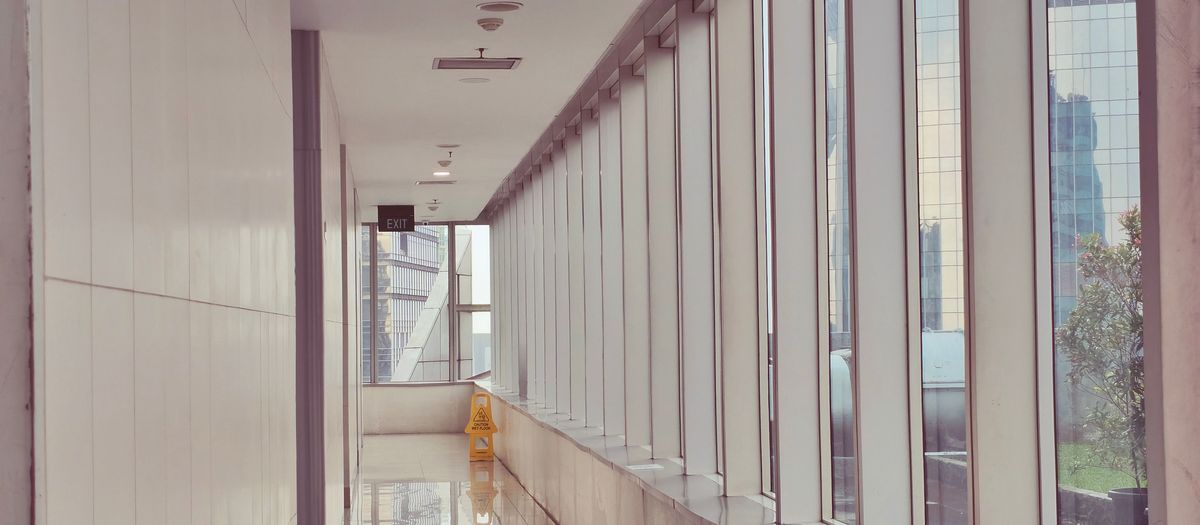
The third is purpose-built office space. Continental Plaza is a three-building Class A complex of around 650,000 square feet on 11.9 acres, joined to its parking deck by pedestrian bridges; Court Plaza, at 19, 21 and 25 Main Street, is marketed by its owner as Class A space. Between them sits older low-rise Main Street stock, which is where most tenant-bought cleaning in the city is done. The Bergen County page covers the rest of the county.
Who Cleans the Building and Who Cleans the Suite?
It depends on which of the three stocks your lease is in, and the lease, not the building’s reputation, is what decides it. As a general pattern rather than a rule for any one address:
| Stock | Typical buildings | Who usually buys the nightly clean |
|---|---|---|
| Amenitised Class A office | Continental Plaza, Court Plaza | Often the landlord, through base rent; tenants add day cover, pantry work and periodic floor care |
| Medical office and outpatient suites | Buildings on and near the Prospect Avenue campus | Usually the practice, under its own written scope, because the clinical rooms need their own order of work |
| Older Main Street office and mixed-use | Low-rise professional buildings, ground-floor suites in new residential buildings | Almost always the tenant |
Where the landlord cleans, the useful question is what the base service leaves out: a day porter through business hours, conference-room resets between meetings, or the carpet work a busy floor needs more often than the building schedules it. Our note on the difference between Class A and Class B cleaning sets out where those lines usually fall. Where the tenant cleans, the whole scope is yours to write, and getting it on paper before the first night saves the arguments later.
What Does a Medical or Legal Tenant in Hackensack Need From a Cleaning Scope?
Sector sets scope here more than anywhere else in the county. We are generalising, but a 950-bed hospital tends to pull physician practices, imaging, therapy and outpatient suites into the streets and buildings around it, and a county courthouse pulls in law offices, title work and the services that support them. Check the directory of your own building rather than assuming either.
A medical suite inside an office building changes the protocol, not just the checklist. Exam and treatment rooms are cleaned in a set order, from clean areas to dirty ones, with touch points disinfected using products the practice approves and given their full dwell time; waiting rooms are cleaned as public space; and anything clinical — sharps, regulated medical waste, specimen areas — stays with the practice and its licensed handlers, not the cleaning crew. Our page on medical office cleaning and patient privacy covers how crews work around records and screens.
Legal offices raise a different concern: paper. Files on desks, privileged documents in conference rooms and shredding bins that must not be emptied into general waste. The scope should say what the crew touches, what it leaves alone, and which rooms stay locked. The hospital’s own clinical floors are a different discipline altogether and outside an office-cleaning scope.
How Does After-Hours Access Work in Hackensack?
By car, mostly, and by building rather than by district. Rail is light: the Pascack Valley Line stops at Essex Street and Anderson Street, two single-platform stations on the line between Hoboken Terminal and Spring Valley, New York, and Essex Street averaged 191 weekday passengers in 2024. The NJ Transit bus terminal on River Street, a block east of Main Street, is the bigger transit hub, with service into Manhattan. The roads that matter are Route 4, Route 17 and Interstate 80, which ring the city.
What that means for a cleaning schedule is parking and entry, not train times. In a Class A complex with a parking deck, ask where an evening crew parks, which door is open after the lobby closes, and whether the security desk keeps a list of authorised names. On Main Street the questions are smaller and more practical: a street door with its own key or code, an alarm panel, and who is called if it goes off. Medical suites often have their own alarm and their own lock-up order, because the last clinician out is not the same person every night. Get after-hours access settled in writing, and keep a record of who holds keys and codes.
What Changes the Cleaning Scope in Hackensack?
Four things, mostly. Winter salt. Surface lots, a parking deck and pedestrian bridges all put salt and grit on lobby and corridor floors from the first freeze, so entry matting and a heavier hard-floor programme between December and March are part of the scope, not extras. Floor and carpet care is usually written around that season.
Change on Main Street. In 2012 the city adopted its Downtown Redevelopment Rehabilitation Plan, rezoning 163 acres from the courthouse to State and River Streets and requiring mixed use on Main Street. Since then former commercial buildings have been converted — the bank building at 210 and 214 Main Street became 127 homes over ground-floor retail — and the Main Street Sears closed in September 2020. New ground-floor suites in new buildings need a post-construction clean before move-in, and fresh fit-out dust keeps appearing for weeks after.
Older floors. Pre-war and mid-century Main Street buildings tend to have worn hard floors and older carpet; our note on carpet and floor care in older buildings covers what is realistic. Glass. Amenitised office lobbies and enclosed bridges show every fingerprint, and interior glass is slow work that needs its own time in the schedule.
Which Local Rules Apply to a Hackensack Office?
New Jersey rules, not New York City ones. Recycling here runs on the state’s mandatory source separation and recycling statute (N.J.S.A. 13:1E-99.11 et seq.), which covers the residential, commercial and institutional sectors. Counties produce recycling plans and municipalities adopt ordinances based on them, so the materials your office must separate are set by the City of Hackensack’s ordinance, read alongside the Bergen County plan, not by anything you used in Manhattan. Commercial tenants normally arrange their own hauling; confirm with your managing agent whether the building’s service already covers your suite.
Equally important is what does not apply: no New York City commercial waste zones, no DSNY separation regime and no New York City prevailing wage schedule. A medical practice has a separate layer of state rules for regulated medical waste, which stays with its licensed hauler. Our waste and recycling management service is written to whichever regime your address sits in, and the note on New York waste and recycling compliance shows what you leave behind at the river.
This is not legal advice, and ordinances change. Confirm what applies at your building with the city, your managing agent or your counsel.
Sources
- Hackensack, New Jersey
- Bergen County Court House
- Bergen County opens new Justice Center — NJBIZ
- Hackensack University Medical Center
- Normandy Real Estate completes Continental Plaza renovation — REBusiness
- Court Plaza, 19, 21 and 25 Main St., Hackensack — Real Estate NJ
- Alfred Sanzari Enterprises — Court Plaza leasing announcement
- Glory days restored: Hackensack mixed-use projects — NJBIZ
- Essex Street station (NJ Transit)
- Anderson Street station
- Hackensack Bus Terminal
- NJDEP Bureau of Recycling and Planning — business recycling
What We Do Here
Nightly office and janitorial cleaning on a written scope, with a fixed monthly price and the exclusions listed in the same document. Day porter coverage where business-hours presence is what you actually need. Scheduled periodic work — deep cleaning, carpet extraction, floor refinishing, high dusting and interior glass — on a published annual calendar so it is budgetable rather than surprising.
How We Start
- A walkthrough, usually thirty minutes. We measure, count restrooms and pantries, look at your floor surfaces and ask how many days you are actually occupied.
- A written scope exhibit and a fixed monthly price within two business days, with the service level agreement in the same document.
- Building onboarding — Certificate of Insurance filed with your managing agent, vendor registration completed, named worker roster submitted for access.
- Service begins, with a weekly supervisor inspection and a monthly scored audit sent to you whether the news is good or not.
What It Costs
Recurring commercial cleaning is quoted as a flat monthly fee built from cleaner-hours per visit. Square footage sets the ballpark; restroom count, pantry density, build-out type, floor mix and glass decide where you land inside it. We give you a fixed monthly price in writing with the cleaner-hours stated, usually within two business days. How pricing works, and what a per-square-foot rate leaves out.
Get a Price for Your Hackensack Office
Send us the square footage and the nights you need. Written scope, fixed price, exclusions listed — usually within two business days.
Hackensack — Get a Price
Written scope and fixed monthly price, usually within two business days.
We reply to every request. If your building needs a Certificate of Insurance or vendor registration, we handle that paperwork before the first night.
Hackensack: Frequently Asked Questions
Do you clean medical offices near Hackensack University Medical Center?
Our landlord at a Class A complex already cleans the suite. What would we add?
Do New York City waste rules apply to a Hackensack office?
Can you start quickly in Hackensack?
Ready for Office Cleaning You Can Actually Check?
Send us your square footage and how many nights you need. You get a written scope, a fixed monthly price, and the SLA in the same document — usually within two business days.