
Commercial Office Cleaning in Jersey City & Exchange Place
We provide nightly commercial office cleaning and janitorial services in Jersey City & Exchange Place. Three commercial markets in one city: the Class A tower stock of Exchange Place and Harborside on the Hudson, the converted railroad warehouses and loft space of the downtown Powerhouse Arts District, and the civic and professional buildings around Journal Square. Most waterfront towers are cleaned by the landlord through base rent; a few streets inland the tenant buys the cleaning, and the questions are the same as in a Manhattan Class B building.
What Kind of Office Buildings Are in Jersey City?
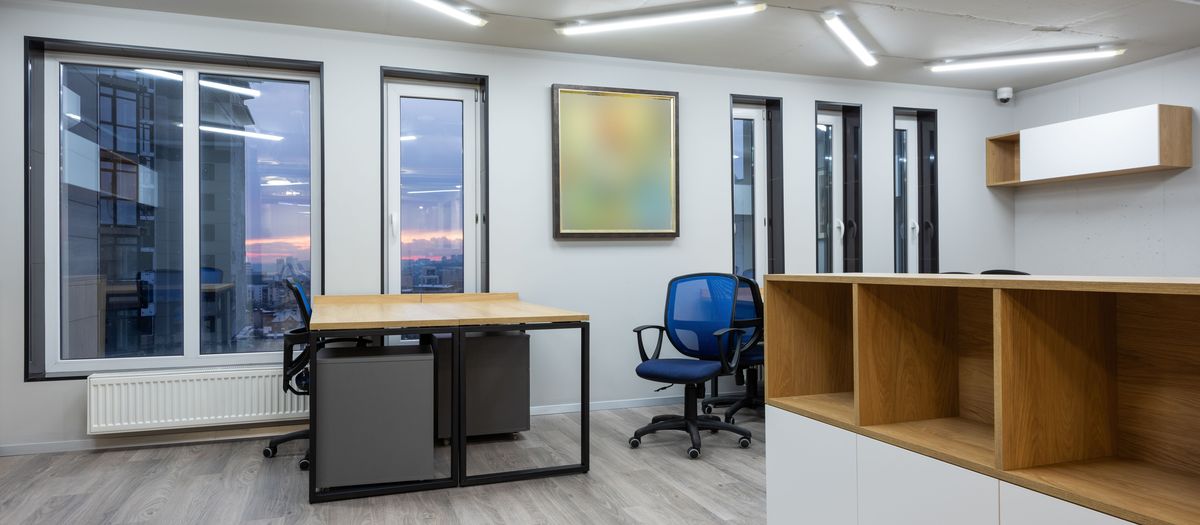
Jersey City is three commercial markets that happen to share a city line, and a cleaning scope written for one of them is wrong in the other two. On the Hudson, Exchange Place and Harborside hold the tower stock. The Goldman Sachs Tower at 30 Hudson Street and 99 Hudson Street are the two tallest buildings in New Jersey, and the district has been called “Wall Street West” for the financial firms clustered there. Harborside Plaza 5 is a 34-storey office building finished in 2002 running to nearly a million square feet; Harborside Plaza 10 was developed for Charles Schwab the same year; Plaza 6 is a smaller office building of around 200,000 square feet sitting over a garage.
Behind the towers the stock gets older and more interesting to clean. Harborside 1, 2 and 3 are three interconnected eight-storey buildings put up between 1927 and 1931 for the Pennsylvania Railroad’s dock and warehouse company — built as a concrete and steel waterfront warehouse and shipping facility, and renovated throughout by May 2022. Inland, Journal Square holds the civic and professional buildings, including the 1928 Labor Bank Building at 26 Journal Square: fifteen floors, 190 feet, and three lifts for the whole building. Downtown, the Powerhouse Arts District is converted industrial — 130 Bay Street is a 1913 former Great Atlantic and Pacific Tea Company warehouse, six storeys, now up to 135,000 square feet of loft space with ceilings reaching 27 feet.
Who Cleans the Building and Who Cleans the Suite?
Settle this before you price anything, because the answer changes within a few streets. In most Class A towers on the waterfront the landlord’s cleaning company already cleans tenant suites and the cost arrives through base rent, so a tenant there who buys a full nightly scope is usually paying twice. A few blocks inland the arrangement inverts and the tenant buys everything. Read your lease, or ask the managing agent, before you ask anyone for a number.
| Where in Jersey City | Who usually buys the cleaning | What is normally still worth buying |
|---|---|---|
| Exchange Place and Newport towers | The landlord, through base rent | Day porter cover, pantry service, periodic deep work |
| Harborside 1–3 and downtown loft space | Usually the tenant | The whole nightly scope |
| Journal Square professional suites | The tenant | The nightly scope, with reception presentation weighted heavily |
We specialise in Class B and Class C buildings, which is most of what Jersey City has once you step back from the river. Where a waterfront tower is landlord-cleaned we are generally the supplemental vendor rather than the nightly one — a day porter through business hours, or periodic work the landlord’s scope does not reach. The difference between Class A and Class B cleaning is the whole of this question.
How Does After-Hours Access Work in Jersey City?
Jersey City is the one part of New Jersey that runs on a Manhattan clock, and that is a transit fact first. PATH trains run around the clock year-round: four routes serve thirteen stations through the day, two during late nights. From Exchange Place the line runs east to the World Trade Center, north to Hoboken Terminal, and west to Journal Square and Newark Penn Station. The Hudson–Bergen Light Rail stops at Exchange Place, Harborside Financial Center and Essex Street, and NY Waterway and Seastreak run from the Paulus Hook ferry terminal.
The caution worth stating is that the late-night pattern is a reduced one and the timetable changes, so check the current PATH schedule rather than assuming the daytime map holds at two in the morning. We do not plan a crew around a train in any case: crews are dispatched from within the region rather than sent through the tunnel at night.
Inside the buildings, lift capacity sets the schedule more than square footage does. Three lifts serving fifteen floors, as at 26 Journal Square, means a cleaning crew and a moving crew cannot both have the building on a Tuesday night. The waterfront towers run formal freight booking and dock scheduling; the converted and loft stock downtown often has one goods lift and a caretaker who holds the key. Both cases need after-hours access settled in writing, and a clear record of who holds keys and access codes, before the first shift.
What Changes the Cleaning Scope in Jersey City?
Four things, and none of them is floor area. The first is the river. Waterfront floors take wind-driven grit and, from roughly November, salt walked in from exterior doors and open plazas; interior glass on an exposed elevation shows it within days. That makes entry matting and a winter frequency on hard floors the real floor-protection programme, not an extra. Our floor and carpet care is usually written around salt season on this side of the river.
The second is ceiling height. Loft space with ceilings reaching 27 feet, as at 130 Bay Street, puts ducts, pipe runs, light fittings and exposed structure far outside the reach of a nightly crew. That work is high dusting — planned, scheduled, and done from proper access equipment rather than quietly skipped because nobody can see it.
The third is the floor substrate. Converted railroad and warehouse buildings mean concrete, sealed timber and hard floor across large spans, where dust mopping and periodic machine work replace the vacuuming a carpeted suite needs; older buildings behave differently from new ones here. The fourth is tenant mix. The downtown loft stock now carries clinical tenants alongside offices — 130 Bay Street has a physical therapy practice and a medical office among its tenants — and a clinical suite inside an office building changes the protocol, the products and the order of work, not just the checklist.
Which Local Rules Apply to a Jersey City Office?
Almost nothing from New York City applies, and tenants moving across the river routinely get this wrong. New Jersey recycling runs on the statewide mandatory source separation and recycling statute signed in 1987 (N.J.S.A. 13:1E-99.11 et seq.), which mandates recycling in the residential, commercial and institutional sectors. Counties produce recycling plans; municipalities adopt ordinances based on the applicable county plan. The consequence: the materials your office must separate are set by the municipal ordinance at your address, not by the state or the county.
Two Hudson County specifics matter. Commercial generators sit outside the municipal collection programmes — each municipality arranges residential collection, a business organises its own — and commercial solid waste generated in the county may only go to facilities designated in the Hudson County Solid Waste Management Plan. An A-901 licensed solid waste transporter is what to look for; the county improvement authority checks hauler licensing with the Hudson Regional Health Commission and the state environmental department.
What is absent matters just as much: no New York City commercial waste zones, no DSNY separation regime, no New York City prevailing wage schedule. Our note on New York waste and recycling compliance describes what you are leaving behind, and our waste and recycling management is written to whichever regime your address sits in. This is not legal advice and ordinances change — confirm what applies at your building with the municipality, your managing agent or your counsel.
What Does a Jersey City Managing Agent Usually Ask a Cleaning Company For?
Paper first, people second. A certificate of insurance naming the right parties is the document that stops a start date slipping, and a Jersey City agent’s requirements are not the ones a Midtown agent uses — different additional insured wording, different limits, sometimes a different broker form. Get the certificate of insurance right before anything else is agreed.
After that, buildings ask who is actually in the suite at night. Our cleaners are W-2 employees, trained before the first shift, background and reference screened, bonded, badged with the managing agent, and checked by a supervisor daily — which is a different answer from bringing in outside labour for the night, and the one most agents here want on file. We have cleaned New York commercial space since November 2019, operate 24/7, answer the phone in under five seconds, can provide same-day service, and go month-to-month after the first 30 days.
One thing we will not claim: we hold no third-party certifications — not Green Seal, not ISSA CIMS, not GBAC. If a Jersey City building’s specification requires one, say so early and we will tell you plainly whether we can meet it rather than find out at the walkthrough. We also will not tell you which buildings in Jersey City we clean; that is the tenants’ business, not marketing material.
Sources
- Exchange Place, Jersey City
- Harborside, Jersey City
- Journal Square
- 26 Journal Square (Labor Bank Building)
- 111 First Street, Jersey City
- Arts & Powerhouse Building, 130 Bay Street — Jersey Digs
- Port Authority Trans-Hudson (PATH)
- Hudson County Environmental Guide — Hudson County Improvement Authority
- NJDEP Bureau of Recycling and Planning — business recycling
What We Do Here
Nightly office and janitorial cleaning on a written scope, with a fixed monthly price and the exclusions listed in the same document. Day porter coverage where business-hours presence is what you actually need. Scheduled periodic work — deep cleaning, carpet extraction, floor refinishing, high dusting and interior glass — on a published annual calendar so it is budgetable rather than surprising.
How We Start
- A walkthrough, usually thirty minutes. We measure, count restrooms and pantries, look at your floor surfaces and ask how many days you are actually occupied.
- A written scope exhibit and a fixed monthly price within two business days, with the service level agreement in the same document.
- Building onboarding — Certificate of Insurance filed with your managing agent, vendor registration completed, named worker roster submitted for access.
- Service begins, with a weekly supervisor inspection and a monthly scored audit sent to you whether the news is good or not.
What It Costs
Recurring commercial cleaning is quoted as a flat monthly fee built from cleaner-hours per visit. Square footage sets the ballpark; restroom count, pantry density, build-out type, floor mix and glass decide where you land inside it. We give you a fixed monthly price in writing with the cleaner-hours stated, usually within two business days. How pricing works, and what a per-square-foot rate leaves out.
Get a Price for Your Jersey City Office
Send us the square footage and the nights you need. Written scope, fixed price, exclusions listed — usually within two business days.
Jersey City — Get a Price
Written scope and fixed monthly price, usually within two business days.
We reply to every request. If your building needs a Certificate of Insurance or vendor registration, we handle that paperwork before the first night.
Jersey City & Exchange Place: Frequently Asked Questions
Do you clean offices on the Jersey City waterfront?
Is a Jersey City office covered by New York City's waste and recycling rules?
Are your crews based in New Jersey rather than driven over from Manhattan?
What slows down starting work in a Jersey City building?
Do you hold Green Seal, ISSA CIMS or GBAC certification?
Ready for Office Cleaning You Can Actually Check?
Send us your square footage and how many nights you need. You get a written scope, a fixed monthly price, and the SLA in the same document — usually within two business days.