
Commercial Office Cleaning in Upper West Side & Columbus Circle
We provide nightly commercial office cleaning and janitorial services in Upper West Side & Columbus Circle. One large mixed-use tower at Columbus Circle, a short run of mid-century office buildings on Broadway in the 60s, and a long tail of medical practices, nonprofits and arts organisations in pre-war and mixed-use buildings further north. Outside the circle, most tenants here buy their own cleaning.
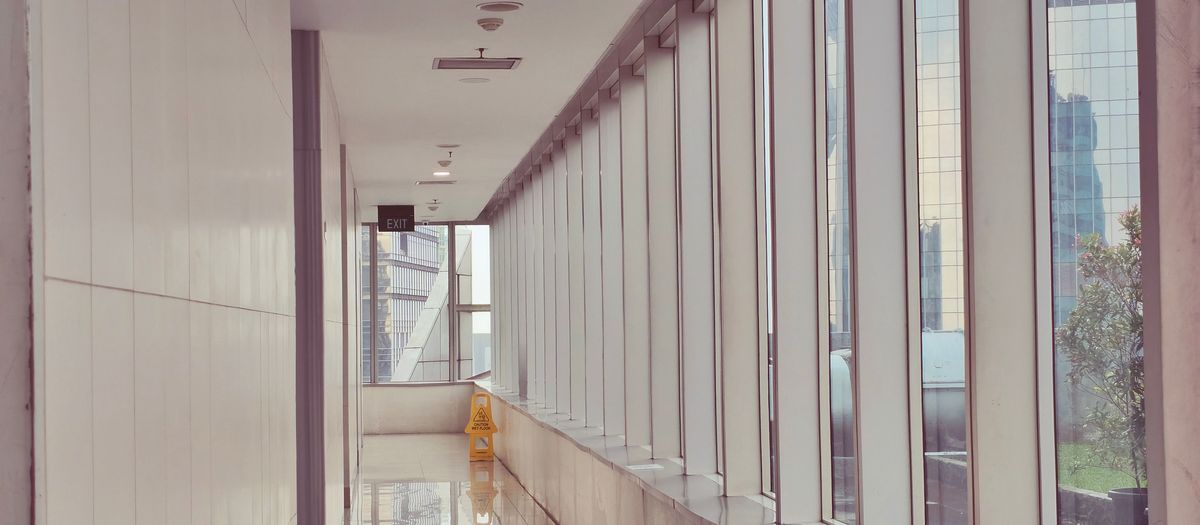
What Kind of Office Buildings Are on the Upper West Side and Around Columbus Circle?
Three kinds, and they clean differently. At the south end is the Deutsche Bank Center, formerly the Time Warner Center, at 1 Columbus Circle: twin 55-storey towers completed in 2003, about 2.8 million square feet in all, of which about 1.1 million is office. Deutsche Bank occupies almost all of that office space. The same building holds the Mandarin Oriental hotel, condominiums, a four-storey shopping centre, Jazz at Lincoln Center’s Frederick P. Rose Hall and a basement garage.
North of the circle, along Broadway in the 60s, are mid-century office buildings. 1995 Broadway, at West 68th Street, is a typical one: an 18-storey Class B building from 1973, about 118,000 square feet, side-core with column-free floors, a glass curtain wall and windows on three sides, listed as suitable for professional and medical use, including physical therapy.
Beyond that, most commercial space is in pre-war and mixed-use buildings: practices on the lower floors of residential buildings, institutional offices around Lincoln Center, and ground-floor suites on Broadway, Amsterdam and Columbus. The demand is real but small-scale. The Lincoln Square Business Improvement District, which runs from Columbus Circle to West 70th Street between Central Park and Amsterdam Avenue, describes its area through Lincoln Center, Juilliard, Fordham University, the New York Institute of Technology and its shops and restaurants, not through office towers.
Who Cleans the Building and Who Cleans the Suite?
It depends on which of those three stocks you are in. The table is a general pattern, not a rule: check your lease and ask the managing agent before you ask anyone to quote.
| Building type | Who usually cleans the suite | What the tenant normally buys |
|---|---|---|
| Class A mixed-use tower at Columbus Circle | Often the landlord’s own cleaning company, through the lease | Supplemental work: a day porter, pantry service, periodic deep cleaning |
| Mid-century Class B office building on Broadway | Usually the tenant; the building cleans the lobby and common areas | The full suite scope, with any clinical rooms scoped separately |
| Practice or office in a residential or mixed-use pre-war building | The tenant, almost always | The suite, its restrooms and often its own entrance or vestibule |
| Institutional or nonprofit office near Lincoln Center | Varies: some institutions run their own facilities staff | Often after-performance or weekend work around a fixed calendar |
We specialise in Class B and Class C buildings, which is most of the stock north of the circle. Our note on Class A against Class B cleaning explains how to tell which situation you are in, and the Manhattan page covers the rest of the borough.
What Do Medical and Arts Tenants Change in the Scope?
Healthcare is the clearest tenant cluster outside the circle. A commercial real estate report on medical office demand, covered by Crain’s, found a low vacancy rate in the uptown medical submarket and listed Mount Sinai West and Mount Sinai Morningside, both on the Upper West Side, among the city’s largest hospitals by footprint. Around them sit outpatient practices: Mount Sinai lists Upper West Side sites at 1090 Amsterdam Avenue, 2875 Broadway, the Ansonia at 2109 Broadway, and 620 and 638 Columbus Avenue.
A practice suite is not an office scope with extra disinfectant. Exam rooms, waiting rooms and staff areas need separate frequencies, product control and a written line on regulated waste: sharps and red-bag waste belong to the practice’s licensed medical waste hauler, not to the cleaning crew. Our medical office protocol and the note on cleaning around patient records set that out.
Arts and educational tenants bring a different constraint: the calendar. Rehearsal and performance schedules around Lincoln Center can make the evening the busiest time of day, so the scope has to say when the crew may enter, which rooms are off limits during a rehearsal, and how nonprofit offices with small teams and shared kitchens are handled on nights nobody is in.
How Does After-Hours Access Work on the Upper West Side?
Transit is not the issue. The 59th Street–Columbus Circle station sits directly beneath the Deutsche Bank Center and serves the 1, A, B, C and D trains, and 66th Street–Lincoln Center is on the 1 and 2. Our crews are dispatched from within each region, so a schedule here does not depend on a train timetable either way. What sets the schedule is the building.
In a mixed-use tower, uses are separated by entrance. At the Deutsche Bank Center the office lobbies are on 58th and 59th Streets, the hotel is entered from 60th Street, and residents use other doors again. A vendor goes where the building’s security office says, with the insurance certificate, worker roster and badges the managing agent asks for in advance.
In a mid-century office building such as 1995 Broadway, listed with 24-hour and controlled access, the crew usually works after the tenants leave under the building’s own access system. In a pre-war residential building, a practice’s staff and the building’s doorman or superintendent decide the window, and quiet matters because people live upstairs. We could not find public information on freight elevator hours for individual buildings here, so ask your managing agent and put the answer in writing.
Two notes cover the paperwork: after-hours building access and the certificate of insurance a building asks for.
What Changes the Cleaning Scope on the Upper West Side?
Street-level entrances, first. A practice or office opening onto Broadway, Amsterdam or Columbus takes in grit all year and rock salt all winter, and a small vestibule has nowhere to trap it. Entry matting and a winter frequency for hard floors and carpet belong in the written scope, not in a later conversation.
Glass, second. Mid-century buildings like 1995 Broadway have curtain walls and windows on three sides. Exterior glass is the building’s business; the interior face of perimeter glass, glass partitions and reception doors are the tenant’s, and they take time if they are to be done properly. Put a frequency on them.
Pre-war fabric, third. Older buildings mean original floors, radiators, deep sills and mouldings that collect dust where a nightly crew does not reach, which is periodic high dusting work. A lobby or entrance with stone floors needs the right chemistry before anyone puts a machine on it.
And change. Low-rise buildings at the Columbus Circle end have been demolished for residential towers: 1841 and 1845 Broadway made way for a 24-storey residential building with ground-floor commercial space, and the former Disney and ABC campus around West 66th Street has left office use. New ground-floor units need a post-construction clean before a tenant opens.
Which Waste Rules Apply to an Upper West Side Office?
Unlike our New Jersey, Long Island and Westchester pages, this one is inside New York City, so DSNY’s business recycling rules apply, and so does the Commercial Waste Zones programme under Local Law 199 of 2019. The 2020 DSNY rule that created the twenty zones defines Manhattan West as community districts 104 and 107, plus commercial establishments on Central Park West. Community District 7 is the Upper West Side, and District 4 lies just south of 59th Street, so both sides of Columbus Circle fall in the same zone.
Manhattan West is Phase 8 of the rollout. DSNY’s published schedule has its sign-up period running from 1 April to 31 May 2027, with the zone fully implemented on 1 June 2027. After that, a business here arranges collection with one of the carters awarded the zone; DSNY’s 2025 list names Action Carting Environmental Services, Classic Recycling New York and Waste Connections of New York. Check the list and the dates again before then, because both have changed before, and use DSNY’s Find Your Zone map to confirm your address.
This is background, not legal advice. Confirm what applies at your address with DSNY, your managing agent or your counsel. Our notes on NYC waste and recycling compliance and waste and recycling management cover what the cleaning crew does and does not do.
Sources
- Deutsche Bank Center
- 1995 Broadway — LoopNet listing
- Lincoln Square neighbourhood — Lincoln Square Business Improvement District
- Lincoln Square, Manhattan
- Demand for medical office space concentrated on the Upper East and Upper West Side — Crain’s New York
- Upper West Side locations — Mount Sinai
- Foundation work begins for 1841 Broadway — New York YIMBY
- DSNY final rule establishing twenty commercial waste zones (2020)
- Commercial Waste Zones rollout schedule — NYC Department of Sanitation
- DSNY final rule on implementation dates, including Manhattan West (2026)
- Commercial Waste Zones awardees by zone — DSNY
What We Do Here
Nightly office and janitorial cleaning on a written scope, with a fixed monthly price and the exclusions listed in the same document. Day porter coverage where business-hours presence is what you actually need. Scheduled periodic work — deep cleaning, carpet extraction, floor refinishing, high dusting and interior glass — on a published annual calendar so it is budgetable rather than surprising.
How We Start
- A walkthrough, usually thirty minutes. We measure, count restrooms and pantries, look at your floor surfaces and ask how many days you are actually occupied.
- A written scope exhibit and a fixed monthly price within two business days, with the service level agreement in the same document.
- Building onboarding — Certificate of Insurance filed with your managing agent, vendor registration completed, named worker roster submitted for access.
- Service begins, with a weekly supervisor inspection and a monthly scored audit sent to you whether the news is good or not.
What It Costs
Recurring commercial cleaning is quoted as a flat monthly fee built from cleaner-hours per visit. Square footage sets the ballpark; restroom count, pantry density, build-out type, floor mix and glass decide where you land inside it. We give you a fixed monthly price in writing with the cleaner-hours stated, usually within two business days. How pricing works, and what a per-square-foot rate leaves out.
Get a Price for Your Upper West Side Office
Send us the square footage and the nights you need. Written scope, fixed price, exclusions listed — usually within two business days.
Upper West Side — Get a Price
Written scope and fixed monthly price, usually within two business days.
We reply to every request. If your building needs a Certificate of Insurance or vendor registration, we handle that paperwork before the first night.
Upper West Side & Columbus Circle: Frequently Asked Questions
Do you clean offices in the Deutsche Bank Center at Columbus Circle?
Do you clean medical practices on the Upper West Side?
Which commercial waste zone is the Upper West Side in?
Can you clean around a rehearsal or performance schedule near Lincoln Center?
Do you hold Green Seal, ISSA CIMS or GBAC certification?
Ready for Office Cleaning You Can Actually Check?
Send us your square footage and how many nights you need. You get a written scope, a fixed monthly price, and the SLA in the same document — usually within two business days.